
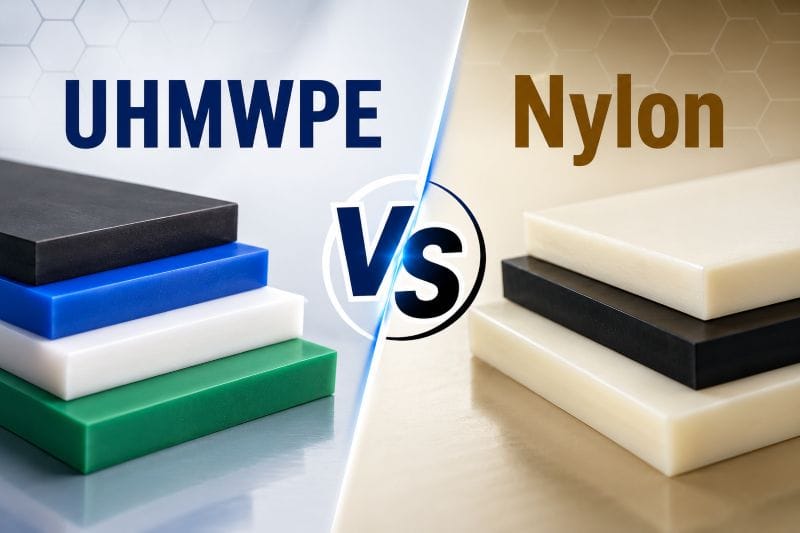
When engineers need a plastic material for wear parts, bearings, bushings, guide rails, rollers, or material-handling components, UHMWPE and Nylon are often two of the first options considered.
Both materials can provide important advantages over conventional metal components, including lower weight, corrosion resistance, and easier fabrication. However, they behave differently under abrasion, mechanical loading, moisture, friction, and impact.
That difference matters when a plastic component is expected to operate continuously inside industrial equipment.
UHMWPE is particularly well suited to applications where low friction, abrasion resistance, impact resistance, and material flow are important. Nylon is often a better candidate when higher stiffness, mechanical strength, and load-bearing performance are required.
The right choice therefore depends less on which material sounds stronger and more on what the component needs to withstand.
This guide compares UHMWPE vs Nylon for common industrial applications, including wear strips, bearings, bushings, gears, conveyor components, and liners. It also explains how moisture, friction, load, temperature, and total operating cost should influence material selection.
For a broader overview of engineering plastic materials and their applications, see Yunzhan’s Engineering Plastics: A Complete Guide to Materials, Properties, Applications, and Selection.
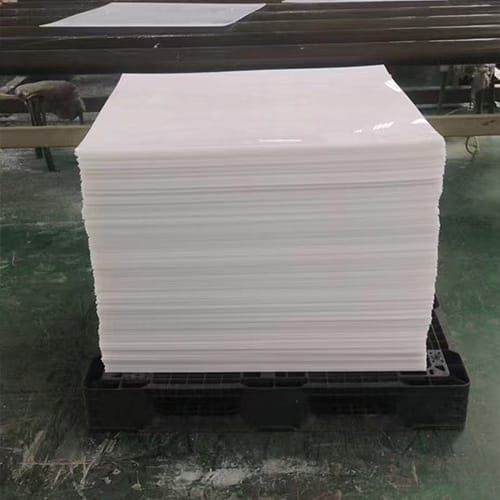
Table of Contents
What Is UHMWPE?
UHMWPE stands for Ultra High Molecular Weight Polyethylene. It is a high-performance polyethylene widely used in industrial applications where abrasion, sliding friction, and impact are major concerns.
UHMWPE is particularly recognized for its combination of:
- Excellent abrasion resistance
- Very low friction
- High impact resistance
- Low moisture absorption
- Good chemical resistance
- Good sliding performance
These properties make UHMWPE suitable for components that are exposed to continuous contact or repeated movement.
Typical applications include:
- Conveyor wear strips
- Chain guides
- Guide rails
- Chute liners
- Hopper liners
- Sliding plates
- Mining wear components
- Material handling liners
- Marine fender components
Yunzhan currently offers UHMWPE Plastic Sheets in large-format dimensions and customizable lengths, making the material suitable for a wide range of industrial wear applications.
What Is Nylon?
Nylon is a family of engineering plastics also known as Polyamide or PA.
PA6 Nylon is widely used for industrial components because it combines mechanical strength, toughness, wear resistance, and machinability.
Compared with UHMWPE, Nylon generally provides greater stiffness and mechanical strength.
It is commonly used for:
- Gears
- Rollers
- Bushings
- Bearings
- Pulleys
- Guide blocks
- Wear components
- Machined mechanical parts
Yunzhan offers PA6 Nylon Sheet as part of its engineering plastic sheet range. The current product range lists PA6 Nylon Sheet with thicknesses from 5 to 100 mm and customizable length options.
Nylon is therefore often considered when a component needs to carry mechanical loads while maintaining good wear and impact performance.
UHMWPE vs Nylon: Key Differences
UHMWPE and Nylon can both be effective engineering plastics, but their performance profiles are different.
| Property | UHMWPE | Nylon |
|---|---|---|
| Abrasion resistance | Excellent | Very good |
| Friction | Very low | Low |
| Impact resistance | Excellent | Very good |
| Stiffness | Moderate | Higher |
| Mechanical strength | Moderate | Higher |
| Moisture absorption | Very low | Higher |
| Chemical resistance | Excellent | Good to very good |
| Dimensional stability in humid conditions | Excellent | More affected by moisture |
| Sliding performance | Excellent | Very good |
| Load-bearing capability | Good | Very good |
| Typical use | Liners, guides, wear strips | Gears, bushings, rollers |
These are general material-selection guidelines rather than universal performance guarantees. The actual result depends on the grade, component design, operating temperature, pressure, speed, mating surface, and environment.
Which Material Has Better Wear Resistance?
For applications where abrasion is the primary concern, UHMWPE is usually the stronger starting point.
UHMWPE is designed for applications where surfaces repeatedly slide against one another or where bulk materials continuously contact a protective liner.
This makes it particularly useful for:
- Conveyor systems
- Mining equipment
- Chutes
- Hoppers
- Material handling systems
- Wear strips
- Sliding guides
Yunzhan’s own technical content identifies UHMWPE as a preferred material for wear-intensive applications and lists conveyor wear strips, chain guides, hopper liners, and chute liners among its common uses.
Nylon also provides good abrasion resistance, but it is often selected when abrasion occurs together with higher mechanical loading.
In other words, if the main problem is continuous sliding wear, UHMWPE deserves serious consideration.
If the component needs to carry higher mechanical loads while resisting wear, Nylon may be more appropriate.
Which Material Has Better Impact Resistance?
Both materials offer good impact resistance, but UHMWPE has a particularly strong reputation for absorbing impact in demanding industrial environments.
This makes it useful for liners and protective surfaces exposed to sudden contact from heavy materials.
For example, mining and bulk material handling equipment may experience repeated impact when rocks, minerals, or other heavy materials enter a hopper or chute.
A UHMWPE liner can provide a protective wear surface while helping reduce direct damage to the underlying equipment.
Nylon also offers good toughness and impact performance, but its higher stiffness makes it more suitable for components where structural support is important.
The key question is whether the material primarily needs to absorb impact or carry mechanical load.
UHMWPE vs Nylon for Bearings
Both UHMWPE and Nylon can be used in bearing and sliding applications, but the operating conditions should determine the final choice.
UHMWPE can be attractive when the application requires:
- Low friction
- Excellent wear resistance
- Chemical resistance
- Moisture resistance
- Impact resistance
Nylon can be attractive when the bearing requires:
- Higher stiffness
- Greater mechanical strength
- Good wear resistance
- Load-bearing capability
- Good machinability
Engineers should evaluate more than material hardness when selecting a bearing material.
Important factors include:
- Radial load
- Axial load
- Shaft speed
- Operating temperature
- Shaft material
- Surface finish
- Lubrication
- Moisture
- Expected service life
A material that performs well in a lightly loaded sliding application may not perform equally well under continuous pressure.
UHMWPE vs Nylon for Bushings
Bushings are another common application where UHMWPE and Nylon may both be considered.
UHMWPE is often useful when low friction and wear resistance are the main requirements.
Nylon can be advantageous when the bushing needs greater stiffness and mechanical strength.
For humid or wet applications, UHMWPE has an additional advantage because it absorbs very little moisture.
This is particularly relevant for:
- Outdoor machinery
- Marine equipment
- Water-handling systems
- Agricultural machinery
- Material handling equipment
Yunzhan’s engineering plastic range is designed for industrial environments where wear, impact, corrosion, and environmental exposure need to be considered.
Which Material Is Better for Conveyor Components?
For many conveyor applications, UHMWPE is an excellent starting point.
Conveyor wear strips and guide components operate continuously and are exposed to repeated sliding contact. Excessive friction can increase wear, noise, energy consumption, and maintenance requirements.
UHMWPE offers a useful combination of:
- Low friction
- High abrasion resistance
- Impact resistance
- Low moisture absorption
- Chemical resistance
This makes it suitable for conveyor wear strips, chain guides, guide rails, and sliding components.
Yunzhan specifically lists conveyor-related applications within its engineering plastic and UHMWPE applications.
Nylon can still be appropriate for conveyor components that require greater structural strength or stiffness.
The decision should therefore be based on whether the component’s primary function is sliding and wear protection or mechanical load support.
UHMWPE vs Nylon for Mining Applications
Mining equipment presents some of the most demanding conditions for engineering plastics.
Components may be exposed to:
- Heavy impact
- Abrasive minerals
- Continuous material flow
- Dust
- Moisture
- Chemical exposure
- Long operating hours
For these conditions, UHMWPE is frequently considered for liners and wear surfaces.
Typical applications include:
- Hopper liners
- Chute liners
- Conveyor components
- Wear strips
- Sliding plates
- Impact protection
Yunzhan identifies Mining & Coal as one of its key application industries, with engineering plastics used to resist material scouring and help extend conveyor equipment service life.
For mining applications, material thickness and fastening method are also important. A highly wear-resistant material can still fail prematurely if the liner is incorrectly designed or installed.
UHMWPE vs Nylon for General Machinery
General machinery creates a broader range of requirements.
A machine may contain:
- Gears
- Bushings
- Rollers
- Guide rails
- Sliding blocks
- Wear pads
- Protective components
These components do not necessarily need the same material.
For example, a sliding guide may benefit from UHMWPE’s low friction, while a mechanically loaded gear may be better suited to Nylon.
Yunzhan lists General Machinery among its application industries, where engineering plastics are used for wear protection and equipment reliability.
This is why material selection should be performed component by component rather than choosing one plastic for the entire machine.
How Moisture Affects UHMWPE and Nylon
Moisture is one of the most important differences between these materials.
UHMWPE has very low water absorption, allowing it to maintain relatively stable dimensions when exposed to moisture.
Nylon absorbs significantly more moisture.
That does not mean Nylon cannot be used in wet environments. It means engineers need to account for moisture when designing components with tight dimensional tolerances.
This becomes particularly important for:
- Precision bushings
- Gears
- Rollers
- Machined components
- Outdoor equipment
If the operating environment is humid and dimensional stability is critical, UHMWPE may have an advantage over standard Nylon.

UHMWPE vs Nylon for Chemical Resistance
UHMWPE generally provides excellent resistance to many industrial chemicals.
This makes it suitable for applications involving chemical exposure, corrosive materials, or wet industrial environments.
Nylon also provides useful chemical resistance, but compatibility depends on the specific chemical, concentration, temperature, and material grade.
Before choosing either material for chemical service, evaluate:
- Chemical type
- Concentration
- Operating temperature
- Exposure duration
- Mechanical loading
For critical applications, chemical compatibility should be verified against the actual operating conditions.
For industrial applications involving chemical exposure, Yunzhan also provides HDPE Plastic Sheets, which can be another material to evaluate depending on the required combination of chemical resistance, stiffness, fabrication, and cost.
Which Material Is Easier to Machine?
Both UHMWPE and Nylon can be machined into custom industrial components.
Nylon is commonly machined into:
- Gears
- Rollers
- Bushings
- Spacers
- Pulleys
- Mechanical components
UHMWPE can also be cut, drilled, milled, and fabricated into custom wear components.
However, its material behavior needs to be considered during machining because the material is relatively flexible compared with stiffer engineering plastics.
Machining quality depends on:
- Material grade
- Component geometry
- Thickness
- Required tolerance
- Tool selection
- Cutting parameters
- Heat generation
For customers requiring custom components rather than standard sheets, Yunzhan also provides customized engineering plastic solutions across its product range.
When Should You Choose UHMWPE?
UHMWPE should be high on the shortlist when the application requires:
- Excellent abrasion resistance
- Very low friction
- High impact resistance
- Moisture resistance
- Chemical resistance
- Continuous sliding performance
- Long wear life
Typical applications include conveyor wear strips, chain guides, chute liners, hopper liners, mining components, and material-handling systems.
If the component’s primary function is to reduce friction or withstand continuous abrasion, UHMWPE is often a logical starting point.
When Should You Choose Nylon?
Nylon is often a better starting point when the application requires:
- Higher stiffness
- Higher mechanical strength
- Good toughness
- Good wear resistance
- Load-bearing capability
- Machinability
Typical applications include:
- Gears
- Rollers
- Bushings
- Bearings
- Pulleys
- Mechanical components
Nylon is particularly useful when the component needs to perform a structural or mechanical function rather than simply act as a wear surface.
However, moisture absorption should be considered if the component operates in humid or wet conditions.
UHMWPE vs Nylon: Which One Should You Buy?
The easiest way to narrow down the choice is to identify the application’s primary requirement.
| Main Requirement | Starting Material |
|---|---|
| Severe abrasion | UHMWPE |
| Continuous sliding | UHMWPE |
| Very low friction | UHMWPE |
| Heavy impact | UHMWPE |
| Wet or humid environment | UHMWPE |
| Higher stiffness | Nylon |
| Higher mechanical strength | Nylon |
| Load-bearing component | Nylon |
| Gears | Nylon |
| Wear strips | UHMWPE |
| Conveyor guides | UHMWPE |
| Bushings | UHMWPE or Nylon |
| Precision mechanical components | Nylon or POM |
These recommendations should be treated as a starting point rather than a final engineering specification.
The actual material should be selected after considering load, temperature, speed, environment, component geometry, and expected service life.
Should You Choose Based on Material Price?
Material price is important, but it should not be the only factor in an industrial purchasing decision.
A lower-cost material may become more expensive if it needs to be replaced frequently.
The total cost of an industrial plastic component can include:
- Material cost
- Machining cost
- Installation
- Maintenance
- Replacement
- Equipment downtime
- Production losses
For high-wear applications, a more durable material can sometimes provide a lower total cost over the component’s service life.
This is particularly important for mining, bulk material handling, and continuous conveyor operations where replacing a wear component may require equipment shutdown.
Instead of asking only “Which material is cheaper?”, buyers should ask:
“Which material provides the required service life at the lowest total operating cost?”
What Should You Tell Your Engineering Plastics Supplier?
When requesting a quotation, providing application information can help the supplier recommend a more suitable material.
Instead of asking only for the price of a plastic sheet, provide:
- Material preference, if known
- Component dimensions
- Required thickness
- Operating temperature
- Mechanical load
- Sliding or rotational speed
- Contact material
- Chemical exposure
- Moisture conditions
- Required service life
- Machining requirements
For example, saying:
“We need a 10 mm plastic sheet.”
does not provide enough information for a reliable material recommendation.
A much more useful specification would be:
“We need a 10 mm wear liner for a conveyor handling abrasive bulk material continuously at room temperature.”
The second description gives the supplier enough information to consider wear, friction, impact, thickness, and expected service life.
How to Select the Right Material for Your Application
UHMWPE and Nylon should not be selected based on a single property.
A practical selection process is:
Application → Operating Conditions → Failure Risk → Required Properties → Candidate Materials → Final Specification
Start by identifying what is most likely to cause the component to fail.
If abrasion is the main concern, prioritize wear resistance.
If deformation under load is the main concern, prioritize stiffness and mechanical strength.
If humidity is a concern, evaluate moisture absorption.
If friction is the main problem, compare the sliding characteristics of suitable materials.
If chemical exposure is expected, check compatibility with the specific chemical and operating temperature.
This application-based approach is more reliable than choosing a material solely because it has a higher strength or lower price.
Why Application-Specific Material Selection Matters
Engineering plastics are not interchangeable.
UHMWPE may outperform Nylon in a highly abrasive sliding application, while Nylon may be the better choice for a mechanically loaded gear.
Likewise, POM may be more appropriate for a precision component where dimensional stability is critical.
This is why the material-selection process should consider the entire operating environment.
Yunzhan’s Engineering Plastic Sheet range includes UHMWPE, HDPE, Nylon, PP, and other plastic sheet solutions, allowing buyers to compare materials according to different industrial requirements.
For a broader material comparison, you can also read UHMW PE Sheet vs HDPE Sheet: How to Choose the Right Material for Industrial Applications. This creates a natural internal link between the two material-comparison articles.
FAQ
Is UHMWPE better than Nylon for wear resistance?
UHMWPE is generally the better starting point for severe abrasion and continuous sliding applications. Nylon can also provide strong wear performance, particularly when higher mechanical strength is required.
Is Nylon stronger than UHMWPE?
Nylon generally provides higher stiffness and mechanical strength, while UHMWPE provides exceptional impact and abrasion resistance. The better choice depends on the type of load.
Is UHMWPE suitable for bearings?
Yes. UHMWPE can be used for bearings and bushings where low friction, wear resistance, impact resistance, and chemical resistance are important.
Is Nylon suitable for outdoor applications?
Yes, but moisture absorption must be considered. Nylon can absorb water from the environment, which may affect dimensions and mechanical properties.
Which material is better for conveyor wear strips?
UHMWPE is generally a strong choice for conveyor wear strips because of its low friction, abrasion resistance, impact resistance, and moisture stability.
Which is better for gears, UHMWPE or Nylon?
Nylon is generally a stronger starting point for gears because of its higher stiffness and mechanical strength. POM can also be considered for precision gear applications.
How do I choose between UHMWPE and Nylon?
Start with the operating conditions. Choose UHMWPE when abrasion, sliding friction, impact, moisture, or chemical resistance are priorities. Consider Nylon when stiffness, strength, and load-bearing performance are more important.
Conclusion
UHMWPE and Nylon are both valuable engineering plastics, but they are designed to solve different industrial problems.
UHMWPE is usually the better starting point for abrasion, continuous sliding, low friction, impact, moisture, and chemical exposure.
Nylon is often more suitable when stiffness, mechanical strength, toughness, and load-bearing capability are important.
For wear strips, conveyor guides, liners, bearings, bushings, gears, and other industrial components, the correct choice depends on the complete operating environment.
Load, speed, temperature, moisture, friction, chemical exposure, component design, and expected service life should all be considered before the material is specified.
For industrial buyers, the goal should not be to find the cheapest plastic or the strongest plastic. The goal is to select the material that provides the required performance and service life at the lowest practical total cost.
If you are comparing UHMWPE, Nylon, HDPE, or other engineering plastics, start with the application requirements and then evaluate the available materials and grades. Yunzhan provides engineering plastic sheets and customized solutions for industrial applications, with product options covering UHMWPE, Nylon, HDPE, PP, and other materials.