
Table of Contents
A conveyor line rarely fails all at once. More often, the first signs are rising noise, uneven chain tracking, black dust near the return path, or a motor drawing more current than expected. When those symptoms appear around a chain path, the guide rail deserves attention. Choosing the right UHMWPE chain guide rail can reduce friction, support smoother movement, and help maintenance teams avoid replacing chains and sprockets earlier than necessary.
This guide is written for engineers, maintenance managers, OEM buyers, and plant teams comparing plastic guide options for packaging, logistics, food processing, textile, paper, and general machinery lines. It explains how to evaluate a UHMWPE chain guide rail by load, profile, installation method, wear pattern, and operating environment. The goal is to make every UHMWPE chain guide rail decision easier to document, quote, and maintain.
Why Chain Guides Wear Out Before the Chain Does
A chain guide is a wear part by design. Its job is to take controlled contact from the moving chain so the frame, sprocket area, and other machine surfaces do not. Problems start when the guide material, profile, or mounting method does not match the motion of the line. A narrow contact area can create heat. A poorly supported guide can flex. A sharp edge can scrape rollers instead of guiding them. In these cases, even a good chain can become noisy and unstable.
A properly specified UHMWPE chain guide rail gives the chain a low-friction path while keeping the guide surface sacrificial and replaceable. UHMWPE is widely used for sliding and wear applications because its long polymer chains give it strong toughness, low moisture absorption, and good resistance to abrasion. For readers who want a material background, ultra-high-molecular-weight polyethylene is a recognized engineering plastic used in many high-wear applications.
When a UHMWPE Chain Guide Rail Is the Right Choice
A UHMWPE chain guide rail is usually a strong option when the conveyor needs quiet movement, corrosion resistance, and reduced lubrication demand. It is often selected for drive chains, return paths, side guides, accumulation conveyors, and transfer sections where metal-to-metal contact would increase noise or wear.
The material is especially useful where water, cleaning chemicals, humidity, or dust make steel guides difficult to maintain. A UHMWPE chain guide rail also helps where operators need cleaner operation because it does not rely on heavy grease in the same way as many metal guide surfaces. That does not remove the need for correct chain maintenance, but it can simplify the wear interface. In a busy plant, a well-matched UHMWPE chain guide rail also gives technicians a more predictable part to inspect during routine service.
Selection Checklist Before Ordering
- Chain type and size: Confirm roller diameter, plate width, pitch, and whether the guide supports the top run, return run, or side contact.
- Running speed: Higher speeds increase frictional heat, so the contact area and guide support become more important.
- Load direction: A vertical load needs different backing support than a side-guiding application.
- Environment: Check moisture, temperature, washdown, chemical exposure, dust, and outdoor UV exposure.
- Mounting method: Decide whether the guide will be drilled, countersunk, clipped into steel backing, or welded to a stainless support channel.
- Replacement access: A UHMWPE chain guide rail should be easy to inspect and replace without dismantling more of the conveyor than necessary.
If the line uses unusual geometry, short runs, or tight tolerances, machined plastic parts may be more practical than standard extrusion. For custom brackets, profiles, and wear components, internal machining capability such as CNC milling plastic parts can help match the guide to the actual machine layout.
Profile and Mounting Options
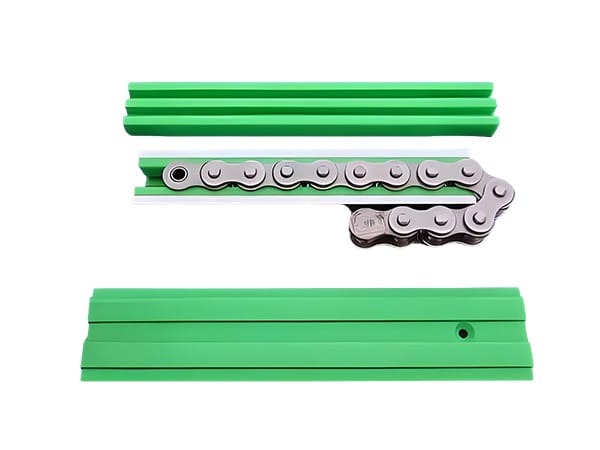
The profile of a UHMWPE chain guide rail should match how the chain contacts it. A UHMWPE chain guide rail selected only by outside dimensions may miss the actual roller path or side-load condition. A flat strip may work for simple sliding support, while T, double-T, K, CT, or CU profiles can provide better chain capture and lateral stability. The correct choice depends on whether the guide is carrying weight, controlling sideways movement, or protecting a return path.
| Design factor | What to check | Why it matters |
|---|---|---|
| Contact width | Chain roller or plate contact area | Spreads load and reduces local wear |
| Backing support | Steel, stainless, or frame mounting | Prevents bending and keeps alignment stable |
| Fastener layout | Hole spacing and countersink depth | Avoids raised hardware in the chain path |
| Expansion allowance | Slotting or end clearance | Helps manage temperature-related movement |
| Inspection access | Visible wear face and removable sections | Reduces downtime during replacement |
Mounting details are not secondary. A good UHMWPE chain guide rail can still perform poorly if screw heads sit proud of the surface, if drilled holes are too close to an edge, or if the backing channel allows vibration. In food, pharmaceutical, or washdown areas, stainless backing and cleanable fixing details may also be important. OSHA’s general machine guarding rules are a useful reminder that conveyor components must be considered within the whole equipment safety system, especially around moving chains and nip points: OSHA 1910.212.

Extruded or Machined: Which Version Fits Better?
Extruded profiles are suitable when the line uses common dimensions and long, repeatable sections. They are efficient for standard conveyor layouts and can simplify spare-part planning. A machined UHMWPE chain guide rail is better when the machine needs tighter dimensional control, special slots, nonstandard holes, curved sections, or small-batch custom parts.
For OEMs, the decision often comes down to repeatability. If the same guide will be used across many machines, extrusion can be a stable route once the profile is proven. If a plant is correcting a wear issue on an existing line, machining may solve the problem faster because the guide can be tailored to the worn frame, available fixing points, or unusual chain path.
Common Signs It Is Time to Replace the Guide
A UHMWPE chain guide rail should be inspected before the chain starts damaging nearby components. Look for uneven grooves, step wear, cracked ends, loose fasteners, heat discoloration, edge curling, or a polished track that is no longer aligned with the chain. A guide that has worn into a deep channel may begin steering the chain incorrectly instead of supporting it. Replacing the UHMWPE chain guide rail before that point protects the chain path and keeps troubleshooting simpler.
Maintenance teams should also listen. A rising scraping sound after a change in product load or conveyor speed can indicate that the UHMWPE chain guide rail is overloaded or under-supported. Noise alone does not identify the cause, but it is a practical early warning when combined with visual inspection and motor load trends.
Installation Notes That Prevent Early Failure
- Clean the mounting surface so the guide sits flat along its full length.
- Check chain alignment before using the guide to force the chain back into position.
- Use countersunk or recessed fasteners where the chain passes over the fixing area.
- Leave suitable end clearance for thermal movement, especially on long runs.
- Replace damaged chain links or sprockets before installing the new guide.
- Record the installation date and inspection interval for each UHMWPE chain guide rail section.
For plants running multiple conveying lines, it is helpful to standardize UHMWPE chain guide rail drawings and spare-part codes. Grouping guide rails by profile, length, hole pattern, and material grade makes future purchasing easier and reduces the risk of installing a similar-looking but incorrect part.
Final Sourcing Checklist
Before confirming an order, send the supplier the chain specification, conveyor speed, load condition, operating temperature, environment notes, preferred profile, drawing or sample, and required quantity. If the application is part of a broader equipment upgrade, reviewing related general machinery plastic applications can also help identify other wear parts that should be standardized at the same time.
The best UHMWPE chain guide rail is not simply the hardest or thickest option. It is the guide that fits the chain path, supports the real load, mounts securely, and can be replaced predictably during planned maintenance. With the right profile and installation details, a UHMWPE chain guide rail becomes a small component that protects a much larger conveyor investment. Treat the UHMWPE chain guide rail as an engineered wear part, not a generic plastic strip.