
Choosing the right engineering plastic can have a major impact on the reliability, service life, and maintenance requirements of industrial equipment.
For many engineers and purchasing teams, the challenge is not finding a plastic material. There are dozens of engineering plastics available, including UHMWPE, HDPE, Nylon, POM, PP, PTFE, PEEK, and other modified or reinforced grades.
The real challenge is deciding which engineering plastic is suitable for a specific application.
A conveyor wear strip, precision gear, chemical tank liner, high-temperature component, and heavy-duty bearing may all require plastic materials, but they do not require the same properties.
A good material selection process should therefore start with the working conditions rather than the material name or purchase price.
This guide explains how to choose engineering plastics based on wear, friction, mechanical load, temperature, chemical exposure, moisture, dimensional stability, machining requirements, and overall cost.
For a broader introduction to the main material families, see our Engineering Plastics: A Complete Guide to Materials, Properties, Applications, and Selection.
Table of Contents
Engineering Plastics Material Selection: Start With the Application, Not the Material
One of the most common mistakes in engineering plastic selection is choosing a material first and trying to make it work afterward.
A better approach is to define the application before comparing materials.
Ask:
- What will the component do?
- What loads will it experience?
- Will it slide, rotate, support, guide, or protect?
- Will it contact metal or another plastic?
- Will it be exposed to water or chemicals?
- What temperature will it operate at?
- How long should it last?
For example, a plastic component used as a conveyor guide needs low friction and wear resistance, while a precision gear needs dimensional stability and predictable mechanical performance.
The material should therefore be selected according to the actual failure risks of the component.
This application-first approach is also useful when comparing engineering plastics suppliers because it allows buyers to evaluate whether a supplier can provide a material suitable for the intended operating conditions rather than simply supplying a standard plastic sheet.
What Properties Matter When Selecting Engineering Plastics?
There is no single property that determines whether an engineering plastic is suitable.
Most industrial applications require a balance of several characteristics.
The most important properties to evaluate include:
| Property | Why It Matters | Typical Applications |
|---|---|---|
| Wear resistance | Determines service life under abrasion | Liners, wear strips, guides |
| Friction | Affects sliding efficiency and heat generation | Bearings, bushings, conveyors |
| Impact resistance | Helps prevent cracking or breakage | Heavy equipment, guards |
| Stiffness | Controls deformation under load | Gears, structural components |
| Chemical resistance | Protects against chemical degradation | Tanks, liners, processing equipment |
| Temperature resistance | Determines usable operating range | Machinery, high-temperature equipment |
| Moisture absorption | Affects dimensions and mechanical properties | Precision components |
| Machinability | Influences manufacturing cost and tolerance | CNC-machined parts |
| Dimensional stability | Important for accurate components | Gears, bushings, fixtures |
The most suitable engineering plastic is the one that provides the right combination of properties for the actual application.
Which Engineering Plastic Is Best for Wear Resistance?
If abrasion is the primary concern, UHMWPE is one of the first materials engineers should consider.
UHMWPE, or Ultra High Molecular Weight Polyethylene, is widely used for applications involving continuous sliding, material flow, and abrasive contact.
Typical applications include:
- Conveyor wear strips
- Chain guides
- Chute liners
- Hopper liners
- Sliding plates
- Material handling components
- Marine fender panels
Its low friction and strong abrasion resistance make it particularly useful where conventional materials wear too quickly.
However, wear resistance should not be considered in isolation.
UHMWPE has lower stiffness than materials such as POM or Nylon, and sustained loading can introduce creep or deformation concerns. Current engineering-plastics guidance also recommends considering load, temperature, and pressure when specifying UHMWPE.
For applications requiring high wear resistance, you can also review our UHMWPE sheet solutions.
When Should You Choose Nylon?
Nylon is often selected when a component needs a combination of mechanical strength, toughness, wear resistance, and impact performance.
Common applications include:
- Gears
- Rollers
- Bushings
- Pulleys
- Guide blocks
- Wear components
- Machine parts
Compared with polyethylene-based materials, Nylon generally provides greater stiffness and mechanical strength.
This makes it attractive for components that need to carry loads rather than simply provide a low-friction sliding surface.
One important consideration is moisture absorption.
Nylon absorbs more moisture than materials such as UHMWPE and POM, which can affect dimensions and mechanical properties. This is particularly important for precision components operating in humid environments.
For a Nylon component with tight tolerances, engineers should consider both the environmental humidity and the expected dimensional changes before finalizing the design.
When Is POM a Better Choice Than Nylon?
POM, also known as Acetal or Polyoxymethylene, is particularly useful for precision mechanical components.
Its combination of:
- Low moisture absorption
- Good stiffness
- Low friction
- Dimensional stability
- Excellent machinability
makes it a popular choice for gears, bushings, rollers, and other precision components.
POM is often preferred over Nylon when maintaining dimensional accuracy is more important than maximum toughness.
For example, a precision gear operating in a humid environment may benefit from POM because its lower moisture absorption helps maintain more consistent dimensions.
Current engineering-plastics guidance also identifies POM as a strong option for low-friction, high-precision components where tight tolerances are important.
You can explore our related POM engineering plastic solutions for industrial applications requiring precision and dimensional stability.
When Is HDPE the Right Choice?
HDPE is a practical choice when an application requires durability, chemical resistance, moisture resistance, and relatively easy fabrication.
It is commonly used for:
- Industrial panels
- Tank liners
- Protective sheets
- Chemical equipment
- Water treatment components
- Fabricated structures
HDPE generally provides a good balance between performance and cost.
It may not offer the extreme wear performance of UHMWPE or the dimensional stability of POM, but it can be an economical solution for many general industrial applications.
For customers looking for durable sheet materials for fabrication and industrial protection, HDPE plastic sheet can be considered when extreme mechanical performance is not required.
Which Plastic Is Best for Low-Friction Applications?
Low friction is important in moving components because excessive friction can increase wear, heat generation, energy consumption, and maintenance requirements.
For many industrial applications, the materials worth considering include:
- UHMWPE
- POM
- Nylon
- PTFE
UHMWPE is particularly attractive for sliding surfaces and material-handling applications.
POM is often better suited to precision moving components such as gears and bushings.
PTFE provides extremely low friction and excellent chemical resistance, but its relatively low mechanical strength and creep characteristics mean it is not automatically the best choice for load-bearing applications.
The best material therefore depends on the combination of friction, load, temperature, and wear requirements.
How Does Temperature Affect Engineering Plastic Selection?
Temperature is one of the most important factors to evaluate before choosing an engineering plastic.
A material that performs well at room temperature may behave differently at elevated temperatures.
As temperature increases, plastics can experience:
- Reduced stiffness
- Increased deformation
- Changes in dimensional stability
- Accelerated creep
- Reduced mechanical strength
For moderate-temperature applications, materials such as POM, Nylon, UHMWPE, and HDPE may be suitable depending on the specific grade and operating conditions.
For significantly higher temperatures, engineers may need to consider materials such as PEEK or other high-performance polymers.
PEEK is designed for applications where high temperature, chemical resistance, and mechanical performance are required, although its higher material cost makes it unnecessary for many standard industrial applications.
This is why operating temperature should be defined before choosing the material rather than after the component has been manufactured.
How Important Is Chemical Resistance?
Chemical exposure can quickly eliminate otherwise suitable materials from consideration.
Before selecting an engineering plastic for chemical service, identify:
- Chemical type
- Concentration
- Operating temperature
- Exposure duration
- Mechanical loading
- Cleaning procedures
HDPE, PP, PTFE, UHMWPE, and other engineering plastics can provide useful chemical resistance, but their performance varies depending on the chemical and operating conditions.
For example, PP is commonly considered for chemical-resistant fabricated components, while PTFE is widely used when extremely high chemical resistance is required.
A material should never be selected solely because it is generally described as “chemical resistant.”
The specific chemical environment matters.
Why Moisture Absorption Matters
Moisture can have a surprisingly large effect on engineering plastic performance.
This is particularly important for Nylon.
When Nylon absorbs moisture, its dimensions and mechanical properties can change. For a general wear component this may be acceptable, but for a precision gear or bushing it can become a significant design issue.
Materials such as POM, UHMWPE, and HDPE have much lower moisture absorption than standard Nylon grades.
Therefore, if the application involves:
- High humidity
- Water exposure
- Outdoor environments
- Frequent washing
- Tight dimensional tolerances
moisture absorption should be part of the material-selection process.
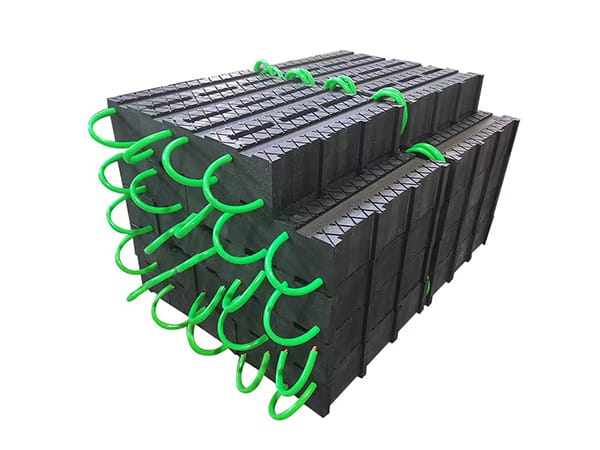
Engineering Plastic Selection for Different Industrial Applications
Different industries tend to prioritize different material properties.
| Application | Important Requirements | Materials to Consider |
|---|---|---|
| Conveyor wear strips | Low friction, abrasion resistance | UHMWPE |
| Chute liners | Impact and abrasion resistance | UHMWPE |
| Precision gears | Dimensional stability, low friction | POM, Nylon |
| Heavy-duty gears | Strength, toughness, wear | Nylon |
| Bushings | Low friction, wear, dimensional stability | POM, Nylon |
| Chemical tanks | Chemical resistance, fabrication | HDPE, PP |
| Water treatment | Moisture and chemical resistance | HDPE, PP |
| High-temperature components | Heat resistance, strength | PEEK, high-performance polymers |
| General industrial panels | Durability, fabrication, cost | HDPE, PP |
| Sliding components | Low friction and wear | UHMWPE, POM, PTFE |
These recommendations are starting points rather than universal rules. The exact grade and formulation should be selected according to the application.
How to Select Between UHMWPE, HDPE, Nylon, and POM
A simple way to narrow down the options is to identify the primary problem the material needs to solve.
If abrasion and sliding wear are the biggest concerns, start with UHMWPE.
If mechanical strength and toughness are more important, Nylon may be a better candidate.
If precision, dimensional stability, and low moisture absorption are priorities, POM deserves consideration.
If chemical resistance, easy fabrication, and cost efficiency are the main requirements, HDPE may provide a practical solution.
This approach prevents buyers from selecting a material simply because it has the highest value for one isolated property.
Should You Choose Plastic Based on Price?
Material price is important, but it should not be the only purchasing criterion.
A cheaper material can become more expensive over its service life if it requires frequent replacement.
Consider the total cost associated with:
- Material purchase
- Machining
- Installation
- Maintenance
- Replacement
- Downtime
- Production losses
For example, a higher-priced UHMWPE wear component may provide better long-term value if it significantly extends replacement intervals.
Similarly, using an expensive PEEK grade where a lower-cost POM or Nylon grade would perform adequately can unnecessarily increase project costs.
The goal is not to find the most expensive material or the cheapest material.
The goal is to find the lowest-cost material that reliably meets the application’s performance requirements.
What Should You Ask an Engineering Plastics Supplier?
Before purchasing engineering plastic sheets, rods, or machined components, industrial buyers should ask the supplier for more than a price quotation.
Important questions include:
- What material grade is being supplied?
- What are the standard dimensions?
- Can the material be customized?
- What tolerances can be achieved?
- Is machining available?
- What technical documentation is provided?
- Can the supplier recommend a material for the application?
- Can the material be tested or sampled before production?
A supplier that understands the application can often provide more value than one that simply offers the lowest unit price.
For larger industrial projects, buyers should also consider production capacity, quality control, consistency between batches, and the supplier’s ability to maintain specifications over long-term orders.
A Practical Engineering Plastics Selection Process
A reliable selection process can be summarized as:
Application → Operating Conditions → Required Properties → Candidate Materials → Testing → Final Material Specification
For example, imagine a manufacturer needs a replacement material for a conveyor guide.
The process could be:
Application: Conveyor guide
Main problem: Excessive wear
Operating condition: Continuous sliding contact
Required properties: Low friction and abrasion resistance
Candidate materials: UHMWPE, POM, Nylon
Final selection: Based on load, speed, temperature, mating surface, and expected service life
This method provides a much more reliable basis for material selection than simply asking which plastic is “strongest.”
Why Application-Specific Material Selection Matters
Engineering plastics are not interchangeable commodities.
Two materials may appear similar on a datasheet but behave very differently in actual equipment.
For example:
- Nylon may outperform POM in an impact-heavy application.
- POM may outperform Nylon where dimensional stability is critical.
- UHMWPE may outperform both in abrasive sliding applications.
- HDPE may be more economical for general fabricated structures.
- PEEK may be justified when high temperature or demanding chemical conditions exceed the capabilities of standard engineering plastics.
The correct material is therefore determined by the relationship between material properties and operating conditions.
That is the most important principle for engineers and industrial buyers to remember.
FAQ
What is the best engineering plastic for industrial applications?
There is no single best engineering plastic. UHMWPE, HDPE, Nylon, POM, PTFE, PEEK, and other materials are suitable for different operating conditions. The correct choice depends on load, wear, temperature, chemicals, moisture, friction, and required service life.
Which engineering plastic is best for wear resistance?
UHMWPE is widely used for highly abrasive and sliding applications because of its excellent wear resistance and low friction. Nylon and POM can also provide good wear performance depending on the application.
What engineering plastic is best for precision parts?
POM is often a strong choice for precision components because of its dimensional stability, low moisture absorption, low friction, and good machinability.
Is Nylon suitable for humid environments?
Nylon can be used in humid environments, but it absorbs more moisture than materials such as POM, HDPE, and UHMWPE. Engineers should consider the resulting dimensional and mechanical changes when tight tolerances are required.
Is UHMWPE stronger than Nylon?
Not in every mechanical property. Nylon generally provides greater stiffness and mechanical strength, while UHMWPE offers exceptional impact resistance, abrasion resistance, and low friction. The better material depends on the application.
How do I choose the right engineering plastic supplier?
Look beyond price. Evaluate material consistency, available grades, customization, machining capability, quality control, technical support, documentation, and the supplier’s ability to recommend materials according to actual application requirements.
Conclusion
Choosing the right engineering plastic starts with understanding the application.
Instead of asking which material is universally “best,” engineers and buyers should first identify the conditions the component must withstand.
For wear and low-friction applications, UHMWPE is often an excellent starting point.
For mechanical strength and toughness, Nylon may be more suitable.
For precision components and dimensional stability, POM is often a strong candidate.
For chemical-resistant fabricated parts and general industrial applications, HDPE or PP may provide a better balance of performance and cost.
For extreme temperature and demanding chemical environments, high-performance materials such as PEEK may be necessary.
A well-defined selection process can help reduce premature component failure, unnecessary material costs, and maintenance problems.
YunZhan provides a range of engineering plastic materials and customized solutions for industrial applications. If you already know the operating conditions of your component, the next step is to match those requirements with the right material, grade, thickness, and processing method.