
Introduction
Choosing an industrial plastic sheet is rarely as simple as picking a material name from a catalog. Two sheets made from the same polymer can perform very differently if the thickness, surface finish, machining method, operating load, or installation environment is not matched to the actual application.
For procurement teams, engineers, fabricators, and equipment manufacturers, plastic sheet thickness affects almost every practical outcome: rigidity, impact resistance, wear life, weight, machining stability, fastening method, installation cost, and long-term reliability. A sheet that is too thin may flex, crack, deform, or wear out early. A sheet that is unnecessarily thick may increase weight, machining time, and material waste without improving performance in a meaningful way.
This guide explains how to choose the right plastic sheet thickness for industrial applications. It also compares common engineering plastic sheet materials, including HDPE, UHMWPE, PP, nylon, and PVC, so you can make a better decision before requesting a quotation or sending technical drawings to a supplier.
The goal is not to give one universal thickness for every project. Industrial applications vary too widely for that. Instead, this guide gives you a practical selection framework: what to check, what trade-offs to consider, and what information to provide when ordering custom plastic sheet or CNC machined plastic parts.
Why Plastic Sheet Thickness Matters
Thickness is one of the first specifications buyers mention, but it is often chosen too quickly. Many customers start with a size they used before, a dimension copied from a metal part, or a sheet thickness that happens to be available locally. That can work for simple panels, but it may create problems in demanding industrial environments.
Plastic materials do not behave exactly like steel, aluminum, wood, or rubber. They have different stiffness, thermal expansion, wear behavior, chemical resistance, and machining characteristics. For this reason, plastic sheet thickness should be selected based on the job the sheet must perform.
In a wear liner, thickness helps determine service life and how much material can be worn away before replacement. In a ground protection mat, thickness affects load distribution and surface stability. In a machined guide rail, the required thickness depends on the final component shape and the amount of material removed during CNC processing. In a chemical tank or equipment lining, sheet thickness must work together with chemical compatibility, support structure, welding, and fastening design.
The correct thickness also helps avoid hidden costs. If a sheet flexes too much after installation, the user may need extra supports or more frequent replacement. If the sheet is too thick for the fabrication method, cutting, drilling, or welding may become slower and less efficient. A good selection balances performance, fabrication, and practical installation.
Start With the Application, Not the Material Name
Before comparing HDPE sheet, UHMWPE sheet, PP sheet, nylon sheet, or PVC sheet, define what the plastic part must do. The same material can be suitable or unsuitable depending on the duty.
Ask these questions first:
- Will the sheet be used as a flat panel, liner, wear strip, cutting board, tank wall, machine guard, sliding plate, or structural support?
- Will it carry static load, moving load, point load, impact, or repeated vibration?
- Will the surface experience sliding contact, abrasive particles, sharp objects, or heavy equipment traffic?
- Will it be exposed to chemicals, moisture, UV, cold temperatures, heat, or food contact requirements?
- Will the sheet be cut only, or will it be CNC machined into a finished component?
- Will it be mechanically fastened, welded, bonded, supported by a frame, or installed as a free-spanning panel?
These questions matter because thickness is not only a dimension. It is part of the engineering solution. A 10 mm sheet used as a fully supported liner behaves very differently from a 10 mm sheet used as an unsupported panel. A thick sheet may still fail if the wrong material is exposed to an incompatible chemical. A thinner sheet may perform well if it is supported correctly and used in a low-load environment.
Key Factors That Influence Plastic Sheet Thickness
1. Load Type and Support Structure
Load is one of the most important thickness drivers. A plastic sheet used as a cover, pad, mat, or support plate must distribute force without excessive bending or permanent deformation.
For fully supported surfaces, such as liners attached to a metal chute or panels mounted on a rigid base, thinner sheets may be acceptable because the backing structure carries most of the load. For partially supported or unsupported applications, thickness usually needs to increase because the sheet itself must resist bending.
Point load is especially important. A machine foot, wheel, outrigger, pallet edge, or narrow contact area can create high local stress. In these cases, increasing thickness may help, but it is not the only solution. A larger contact area, better support, textured surface, or different material may also be needed.
When requesting a custom plastic sheet, provide the supplier with the expected load, contact area, support spacing, and whether the load is static or moving. This information is more useful than saying only, “I need a heavy-duty sheet.”
2. Wear and Abrasion
For liners, guide rails, conveyor parts, chute plates, and sliding surfaces, thickness must account for wear allowance. A thicker sheet gives more usable material before replacement, but the material choice is still critical.
UHMWPE is often selected for high-wear and low-friction applications because it combines strong abrasion resistance with a naturally low-friction surface. HDPE can also work well in many industrial sheet applications, especially where chemical resistance, moisture resistance, and good impact strength are required. Nylon is useful for many mechanical parts, but its moisture absorption and dimensional behavior should be considered in wet environments.
If the sheet will face continuous sliding contact or abrasive bulk material, do not choose thickness alone. Consider wear resistance, coefficient of friction, temperature, fastening pattern, and replacement schedule together.
3. Impact and Shock Resistance
Impact can come from dropped materials, moving equipment, vibration, loading cycles, or accidental contact. In these applications, thickness helps absorb and distribute force, but the polymer’s toughness is just as important.
UHMWPE and HDPE are both known for good impact resistance in many industrial conditions. They are frequently used where toughness, moisture resistance, and outdoor durability are needed. Thicker sheets may improve impact performance, but if the sheet is too rigidly fixed without room for thermal movement, stress can concentrate around fasteners.
For impact-prone applications, discuss the fastening layout, hole diameter, edge distance, backing structure, and expected operating temperature with the supplier. A well-designed installation often performs better than simply ordering the thickest available sheet.
4. Chemical Exposure
Chemical resistance can decide whether a plastic sheet is suitable at all. In chemical tanks, wastewater equipment, plating lines, laboratory fixtures, and industrial processing areas, sheet thickness must be selected only after confirming material compatibility with the specific chemicals and temperatures involved.
PP sheet is widely used in chemical-related fabrication because polypropylene offers good resistance to many acids, alkalis, and aqueous solutions. HDPE also offers strong chemical resistance and low moisture absorption. PVC sheet may be suitable in certain chemical, construction, and fabrication uses, depending on the formulation and service environment.
Thickness should not be used to compensate for poor chemical compatibility. If the chemical attacks the material, a thicker sheet may only delay failure. Always provide the chemical name, concentration, operating temperature, exposure time, and cleaning method when asking for material guidance.
5. Temperature and Outdoor Exposure
Temperature affects plastic stiffness, impact strength, expansion, and long-term dimensional stability. Outdoor use adds more variables, including sunlight, rain, freeze-thaw cycles, dust, and mechanical wear.
HDPE sheet is often chosen for outdoor plastic panels, ground protection products, and moisture-resistant components. UHMWPE is often used for wear parts and impact applications in challenging environments. PP sheet can be strong in chemical and fabrication work, but outdoor exposure and temperature conditions should be reviewed carefully. Nylon can be strong and machinable, but moisture and temperature changes may affect dimensional accuracy.
If the sheet will be installed outdoors, ask about suitable colors, UV-resistant options, expansion gaps, fastener design, and expected temperature range. Plastic expands and contracts more than metal, so a rigid installation with no allowance for movement can create warping or stress.
6. Machining and Fabrication Allowance
Plastic sheet thickness should include enough allowance for cutting, milling, drilling, planing, welding, bending, or surface finishing. This is especially important for custom plastic parts.
For example, a final machined part that is 20 mm thick may require a thicker starting sheet if material must be removed to achieve flatness, tolerance, or surface finish. Complex CNC parts may also need extra stock for clamping, tool clearance, and edge finishing.
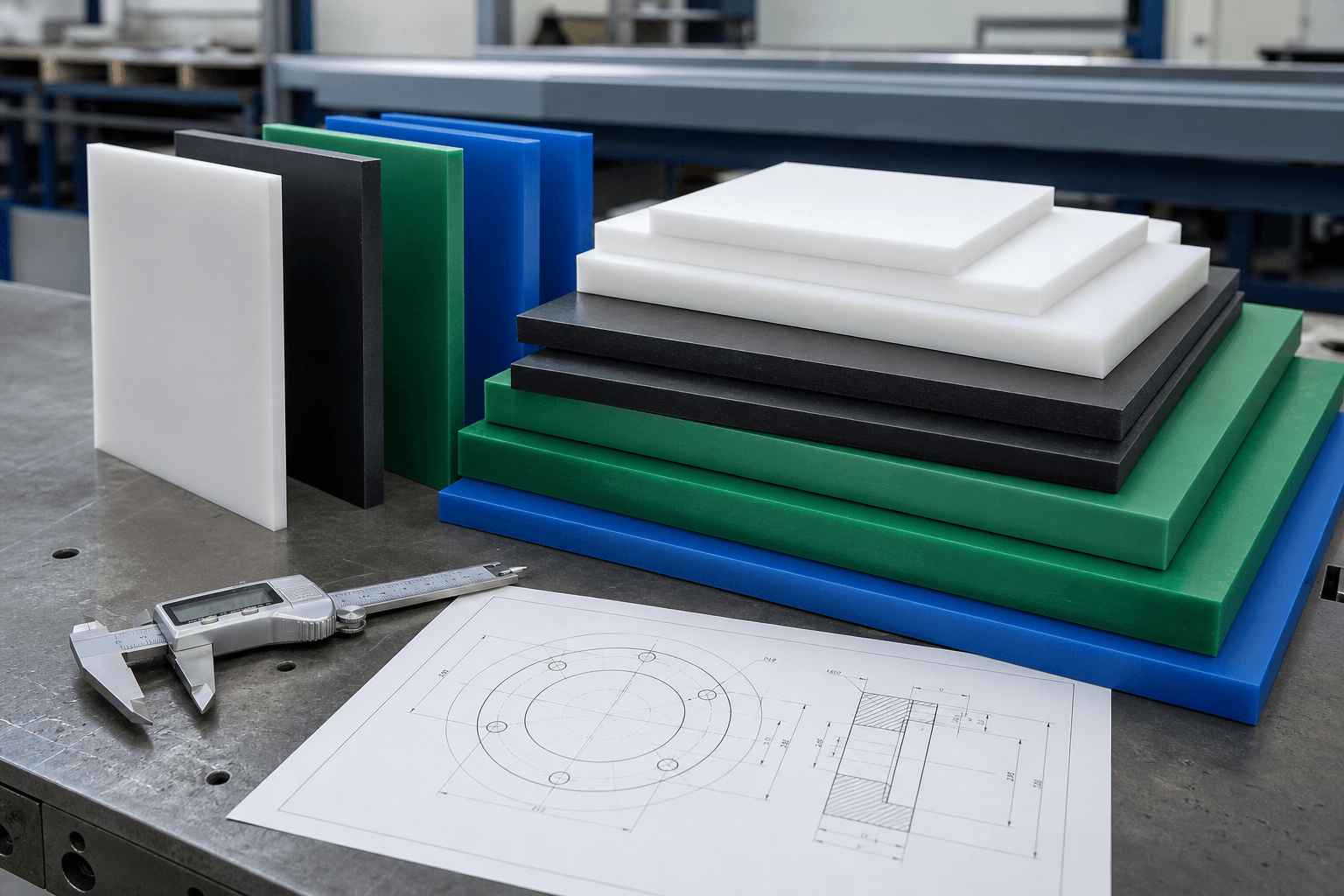
If you need CNC machined plastic parts, provide drawings with final dimensions, tolerances, hole positions, surface requirements, and quantity. The supplier can then recommend a suitable sheet thickness and processing method instead of relying on guesswork.
Common Industrial Plastic Sheet Materials and Thickness Considerations
UHMWPE Sheet
UHMWPE sheet is commonly used where wear resistance, low friction, impact strength, and sliding performance are important. Typical applications include chute liners, conveyor guide rails, chain guides, marine fender facing pads, crane outrigger pads, wear strips, and custom machined components.
When choosing UHMWPE sheet thickness, focus on wear allowance, load distribution, fastening design, and the final machined shape. Thin UHMWPE sheets may work well as supported liners or low-load sliding surfaces. Thicker sheets are often selected for heavy wear, impact, fender facing, outrigger support, or large machined parts.
UHMWPE is also a good option when the plastic part must reduce friction without lubrication. In applications involving sliding contact, the right thickness should be chosen together with surface area and fastening pattern.
HDPE Sheet
HDPE sheet is a versatile industrial plastic sheet used for panels, cutting boards, ground protection mats, tanks, outdoor components, construction sheets, and general fabrication. It offers good toughness, chemical resistance, moisture resistance, and machinability.
When selecting HDPE sheet thickness, consider whether the sheet will be fully supported, used outdoors, exposed to chemical media, or machined into a component. HDPE is often selected for applications where durability and water resistance matter more than extreme wear performance.
For ground protection, heavy equipment support, or impact-prone outdoor use, thickness must be matched to load, ground conditions, mat size, and surface texture. For tank or fabrication work, thickness must be considered together with welding design and support structure.
PP Sheet
PP sheet is often used in chemical tanks, plating equipment, ventilation systems, laboratory fixtures, water treatment, and industrial fabrication. It is valued for chemical resistance, relatively low density, and good processability.
PP sheet thickness should be selected based on chemical exposure, tank size, support spacing, welding requirements, and operating temperature. For fabricated structures, the sheet may need to be thick enough to hold welded joints and resist deformation under liquid load.
Because chemical applications can be highly specific, PP material selection should always be checked against the actual media and working conditions. Provide chemical details before ordering, especially for continuous exposure or elevated temperature service.
Nylon Sheet
Nylon sheet is widely used for gears, bearings, rollers, wear pads, bushings, and mechanical parts that require strength and machinability. It can be an effective engineering plastic material for parts exposed to mechanical stress and movement.
Thickness selection for nylon sheet often depends on the final part geometry. If the sheet will be machined into gears, sliders, blocks, or bearings, enough material must be available for machining and tolerance control.
One important consideration is moisture absorption. Nylon can absorb more moisture than polyolefin materials such as HDPE and UHMWPE, which may affect dimensions in wet or humid environments. For precision parts, discuss operating conditions and tolerance requirements before choosing sheet thickness.
PVC Sheet
PVC sheet is used in fabrication, construction-related panels, chemical equipment, signs, and various industrial components. It can provide useful rigidity and chemical resistance in suitable environments.
PVC sheet thickness should be selected according to rigidity, fastening, welding or bonding method, chemical exposure, and installation design. It may be suitable for panels and fabrication where stiffness is required, but it should be evaluated carefully for impact, temperature, and application-specific conditions.
A Practical Thickness Selection Framework
The following framework can help narrow down the right plastic sheet thickness before ordering.
Step 1: Define the Function
Decide whether the sheet is mainly used for protection, wear resistance, support, sliding, chemical containment, insulation, machining, or appearance. A sheet used as a wear liner has different requirements from a sheet used as a machine side panel.
Step 2: Identify the Main Failure Risk
Ask what would cause the sheet to fail first. Possible risks include bending, cracking, wear-through, chemical attack, UV degradation, fastener pull-through, thermal movement, dimensional change, or poor machining stability.
Once the main risk is clear, thickness can be selected to reduce that risk. If wear-through is the risk, add wear allowance. If bending is the risk, consider thickness, support spacing, and material stiffness. If chemical attack is the risk, change the material before increasing thickness.
Step 3: Confirm the Support Condition
A plastic sheet bolted to a full metal backing can often be thinner than a sheet spanning an open frame. Support spacing, load direction, fastener pattern, and edge restraint all affect performance.
If the sheet is unsupported or only supported at the edges, provide drawings or photos of the installation area. The supplier may recommend increasing thickness, adding ribs, changing material, or modifying the support design.
Step 4: Check Fabrication Requirements
If the sheet will be CNC machined, welded, drilled, countersunk, grooved, or cut into complex shapes, allow enough thickness for processing. Thin sheets may be harder to hold flat during machining. Thick sheets may require more machining time and different tooling.
For custom plastic sheet fabrication, drawings are extremely valuable. Include final dimensions, hole diameter, slot length, tolerances, edge finish, and any surface requirements.
Step 5: Consider Installation and Maintenance
The best thickness is not only the one that performs well in theory. It must also be practical to install, replace, clean, and transport. Heavy sheets may require lifting equipment. Thin sheets may be easier to handle but less durable in abrasive service.
For parts that are expected to wear over time, design for replacement. A slightly thicker wear liner may reduce replacement frequency, but a modular design may make maintenance easier than one large panel.
Thickness Guidance by Application
Wear Liners and Sliding Plates
For chute liners, hopper liners, conveyor guides, and sliding plates, thickness should include enough wear allowance for the expected service life. UHMWPE is often preferred for low-friction and wear-intensive applications, while HDPE may be suitable for general wear and chemical resistance conditions.
Important factors include abrasive material type, particle size, sliding speed, load pressure, fastening layout, and whether the liner is fully supported.
Ground Protection and Heavy Equipment Mats
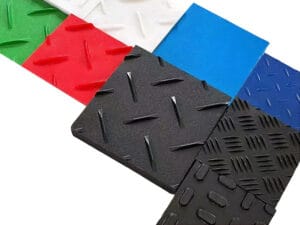
For ground protection mats, thickness must work with material strength, mat size, ground condition, vehicle weight, tire or track contact area, and surface pattern. A mat used on firm soil for light vehicles has different requirements from a mat used on muddy ground with heavy equipment.
HDPE and UHMWPE materials are commonly used for durable plastic ground protection products. When choosing thickness, provide the equipment type, maximum load, ground condition, turning behavior, and whether the mats will be moved frequently.
Crane Outrigger Pads and Support Plates
Outrigger pads require careful attention because they help distribute concentrated load from lifting equipment. Thickness is only one part of the selection. Pad area, material, ground bearing capacity, crane setup, outrigger foot size, and safety practices all matter.
UHMWPE is often selected for outrigger pads because it combines impact resistance, durability, and manageable weight compared with many traditional alternatives. For safety-critical lifting applications, always follow equipment requirements and engineering guidance.
Chemical Tanks and Industrial Fabrication
For tanks, ducts, scrubbers, plating lines, and water treatment equipment, sheet thickness depends on chemical compatibility, liquid pressure, welding design, support structure, and temperature. PP, HDPE, and PVC may all be considered depending on the media.
Do not select chemical tank sheet thickness based only on a general online chart. Provide the tank size, liquid height, support spacing, chemical details, temperature, and welding requirements so the supplier can recommend an appropriate material and thickness.
CNC Machined Plastic Parts
For machined components, the starting sheet thickness should be chosen from the final part drawing. A plastic gear, guide rail, spacer, block, or bearing plate may require additional stock for machining and tolerance control.
Material behavior during machining also matters. UHMWPE and HDPE machine well but require proper tooling and workholding to control burrs and dimensional accuracy. Nylon machines well for mechanical parts, but environmental conditions should be considered if tight tolerances are required.
What Information to Send When Requesting a Quote
To receive a more accurate recommendation from a plastic sheet manufacturer or supplier, provide more than length, width, and thickness. A good request should include:
- Material preference, if known
- Required sheet size or finished part dimensions
- Target thickness or performance requirement
- Application and working environment
- Load type and contact area
- Chemical exposure, if any
- Temperature range and outdoor exposure
- Whether the sheet is supported, bolted, welded, or machined
- Drawings, photos, or samples for custom parts
- Color, surface texture, and quantity requirements
If you are unsure about the material, describe the problem you are trying to solve. For example, “The current liner wears out too quickly,” “The panel bends between supports,” or “The part must resist chemicals and outdoor exposure.” This helps the supplier recommend a practical engineering plastic sheet instead of simply quoting the nearest stock item.
Common Mistakes to Avoid
Choosing Thickness Based Only on Availability
Stock availability is important, but it should not be the only decision factor. A sheet that is easy to buy may not be suitable for the operating load, wear level, or chemical environment.
Copying Metal Thickness Directly
Plastic and metal have different stiffness and expansion behavior. A plastic replacement part may need a different thickness, support pattern, or design adjustment to perform well.
Ignoring Thermal Expansion
Plastic sheets expand and contract with temperature changes. Outdoor panels, long liners, and large machined sheets should be installed with suitable clearance and fastening design.
Overlooking Fastener Stress
Cracks, deformation, and pulled fasteners often begin around holes. Hole size, edge distance, washer design, slotting, and fastening torque all affect performance.
Treating All Plastic Sheets as the Same
HDPE sheet, UHMWPE sheet, PP sheet, nylon sheet, and PVC sheet have different strengths. The best material depends on the application, not only the name “plastic sheet.”
Why Work With a Custom Plastic Sheet Manufacturer
Industrial plastic sheet projects often need more than standard sheet supply. Many buyers require cut-to-size panels, drilled holes, CNC machined parts, textured surfaces, custom colors, special thicknesses, or fabrication support.
Working with a custom plastic sheet manufacturer can help reduce specification errors. Instead of ordering sheet material first and solving problems later, you can review the actual application, drawings, and performance needs before production.
Yunzhan Plastic Industry supplies engineering plastic sheets and custom processed plastic components for industrial applications, including UHMWPE, HDPE, PP, nylon, PVC, and related products. For buyers who need sheet material as well as machining or fabrication, this can simplify sourcing and help ensure the selected material matches the final use.
Conclusion
The right industrial plastic sheet thickness depends on more than a number in millimeters. It depends on load, wear, support, chemical exposure, temperature, machining, installation, and maintenance expectations.
For general industrial use, HDPE sheet offers a strong balance of toughness, chemical resistance, and moisture resistance. UHMWPE sheet is often the better choice for severe wear, low friction, and impact applications. PP sheet is widely used in chemical fabrication, nylon sheet is suitable for many mechanical parts, and PVC sheet can be useful where rigidity and fabrication compatibility are needed.
If you are selecting plastic sheet for a new project, start with the application and failure risk. Then choose the material and thickness together. When in doubt, send your drawings, operating conditions, and installation details to a supplier before placing the order. A short technical discussion at the beginning can prevent costly material changes later.
FAQ
What is the best thickness for industrial plastic sheet?
There is no single best thickness for every industrial plastic sheet. The correct thickness depends on the material, load, support structure, wear level, chemical exposure, temperature, and whether the sheet will be machined or installed as a panel.
Is thicker plastic sheet always stronger?
Thicker plastic sheet can improve rigidity, impact resistance, and wear allowance, but it is not always the best solution. Material choice, support design, fastening method, and chemical compatibility can be more important than thickness alone.
Which material is better for wear resistance, HDPE or UHMWPE?
UHMWPE is generally preferred for high-wear and low-friction applications. HDPE is still a durable and versatile material for many industrial sheet applications, especially where chemical resistance, moisture resistance, and general toughness are required.
Can HDPE sheet be used outdoors?
HDPE sheet is commonly used in outdoor applications because it offers good moisture resistance and toughness. For long-term outdoor use, confirm UV resistance, color, temperature range, and installation design with the supplier.
What plastic sheet is suitable for chemical tanks?
PP, HDPE, and PVC may be suitable for different chemical tank applications, depending on the chemical media, concentration, temperature, tank structure, and welding method. Always confirm compatibility before selecting material and thickness.
Can plastic sheets be CNC machined into custom parts?
Yes. UHMWPE, HDPE, PP, nylon, PVC, and other engineering plastic sheets can be cut and CNC machined into custom parts. Provide drawings, tolerances, quantity, and application details so the manufacturer can choose the correct sheet thickness and processing method.
What should I include in a custom plastic sheet inquiry?
Include material preference, size, thickness, application, load conditions, chemical exposure, temperature range, support method, machining requirements, color, surface texture, quantity, and drawings or photos if available.