

Table of Contents
Introduction
Construction sites, infrastructure projects, utility works, and heavy equipment operations all face the same fundamental challenge: maintaining safe ground access while protecting the underlying surface from damage and deformation.
To solve this problem, contractors rely on ground protection systems such as plastic ground protection mats and steel mats. Both are designed to distribute heavy loads and improve site accessibility, but their performance characteristics differ significantly in terms of strength, weight, installation efficiency, cost, and long-term usability.
Choosing the wrong solution can lead to increased operational cost, slower project progress, ground damage, or even equipment instability.
This article provides a comprehensive engineering and practical comparison between plastic ground protection mats and steel mats to help contractors, engineers, and procurement teams make informed decisions.

What Are Plastic Ground Protection Mats
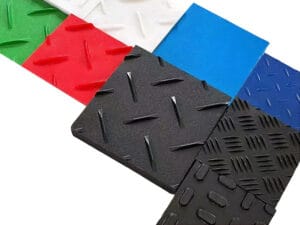
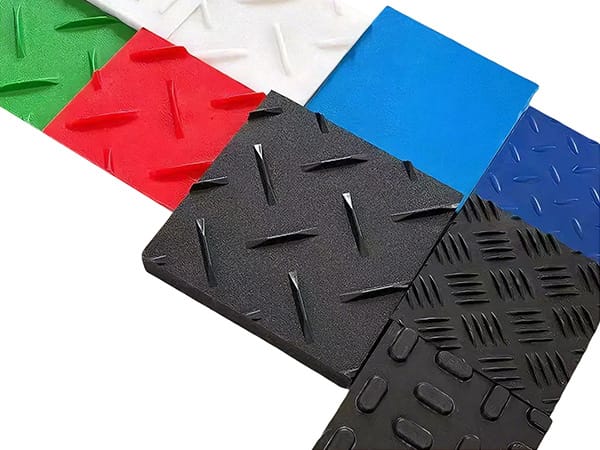
Plastic ground protection mats are high-strength engineered panels manufactured from materials such as UHMWPE (Ultra High Molecular Weight Polyethylene) or HDPE (High Density Polyethylene). They are designed to create temporary stable surfaces for vehicles, cranes, and heavy machinery operating on soft, uneven, or sensitive ground conditions.
These mats distribute concentrated loads across a wider surface area, significantly reducing ground pressure and preventing rutting, sinking, or surface damage.
They are widely used in construction access roads, pipeline projects, wind farm installations, landscaping protection, military logistics, and outdoor events where temporary but stable access is required.
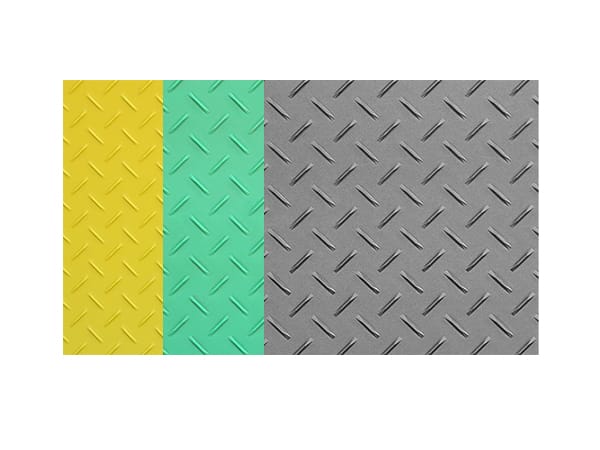
Modern plastic mats are engineered with anti-slip textures, modular connection systems, and high load-bearing capacity, making them suitable for repeated industrial use.
What Are Steel Ground Protection Mats
Steel ground protection mats are heavy-duty load-bearing platforms manufactured from thick steel plates or reinforced steel structures. They are designed for extreme load conditions where maximum structural rigidity is required.
These mats are often used in mining operations, oil and gas projects, heavy industrial sites, and specialized engineering applications where equipment weight exceeds standard construction limits.
While steel mats provide exceptional structural strength, their heavy weight and handling requirements significantly limit flexibility in modern construction environments.
Engineering Principle Behind Ground Protection Mats
Both plastic and steel mats operate based on the same fundamental principle: reducing ground pressure by increasing contact area.
Ground Pressure = Load ÷ Contact Area
By increasing the contact area, the pressure applied to soil or surface decreases, preventing deformation or collapse.
However, material behavior differs significantly. Plastic mats absorb minor impact energy through controlled flexibility, while steel mats rely entirely on rigid structural resistance.
Key Performance Comparison
| Feature | Plastic Ground Protection Mats | Steel Mats |
|---|---|---|
| Weight | Lightweight | Extremely heavy |
| Installation | Fast and easy | Requires heavy machinery |
| Ground Protection | Excellent, non-damaging | Can damage soft surfaces |
| Corrosion Resistance | Fully resistant | Prone to rust |
| Impact Behavior | Slight flexibility, shock absorption | Rigid, no absorption |
| Load Capacity | High (engineered design dependent) | Very high |
| Transport Cost | Low | High |
| Maintenance | Minimal | Requires anti-rust care |
| Reusability | High | High but labor-intensive |
Load Capacity and Structural Performance
Steel mats are traditionally considered the strongest option due to their rigid structure and ability to handle extreme concentrated loads. They are often used in environments where equipment weight is exceptionally high and mobility is not required.
However, modern plastic ground protection mats made from UHMWPE or reinforced HDPE have significantly improved load performance. They are now capable of supporting cranes, excavators, and heavy transport vehicles while maintaining structural integrity under repeated use cycles.
In many real construction environments, plastic mats provide sufficient strength while delivering higher operational efficiency.
Ground Surface Protection Capability
One of the strongest advantages of plastic ground protection mats is their ability to protect sensitive or finished surfaces. They distribute load evenly and prevent direct contact damage to asphalt, grass, soil, or landscaped areas.
Steel mats, due to rigid contact behavior, may cause indentation or surface damage if installed on soft ground without proper base preparation.
For urban construction, landscaping, and temporary access routes, plastic mats are generally the safer and more surface-friendly option.
Installation Efficiency and Operational Flexibility
Plastic ground protection mats are significantly easier to install due to their lightweight structure. Workers can deploy them manually or with small equipment, which reduces setup time and labor dependency.
They are also modular, allowing fast coverage of large working zones without heavy lifting machinery.
Steel mats require cranes, forklifts, or specialized handling equipment, which increases setup time, operational complexity, and overall project cost.
Cost Analysis and Lifecycle Value
Although steel mats may appear more durable in terms of raw strength, total lifecycle cost is often significantly higher. Transportation, installation equipment, labor, and maintenance requirements increase overall expenditure.
Plastic ground protection mats provide better lifecycle economics. Their lightweight design reduces logistics costs, while their durability supports repeated reuse with minimal maintenance.
For most contractors, plastic mats offer a lower total cost of ownership over time.
Safety and Environmental Performance
Plastic ground protection mats are resistant to moisture, chemicals, UV exposure, and corrosion. This makes them suitable for long-term outdoor use across diverse environmental conditions.
Steel mats require ongoing maintenance such as anti-rust treatment and structural inspection, especially in wet or coastal environments.
From a safety perspective, plastic mats also reduce handling risks due to lower weight and easier installation procedures.
Application Scenarios
Plastic ground protection mats are widely used in construction access roads, temporary working platforms, pipeline installation, wind and solar energy projects, event infrastructure, and landscaping protection.
Steel mats are typically used in mining operations, heavy industrial zones, oil and gas sites, and specialized engineering environments where extreme load capacity is the primary requirement.
Maintenance and Durability Considerations
Plastic ground protection mats require minimal maintenance. Periodic cleaning and basic inspection are usually sufficient. High-quality UHMWPE mats can withstand thousands of load cycles under industrial conditions.
Steel mats require regular inspection for corrosion, weld integrity, and structural deformation. Protective coatings or anti-rust treatments are necessary to extend service life.
Which Solution Should You Choose?
The selection depends on project requirements and operational priorities.
If your project requires fast installation, frequent relocation, ground protection, and cost efficiency, plastic ground protection mats are the superior choice.
If your project involves extreme static loads with minimal movement and long-term fixed positioning, steel mats may still be appropriate.
In most modern construction and infrastructure projects, plastic ground protection mats are increasingly preferred due to their balance of performance, efficiency, and practicality.
Conclusion
Plastic and steel ground protection mats both serve important roles in heavy-duty applications, but they are designed for different operational needs. Steel mats provide maximum structural strength, while plastic ground protection mats offer superior flexibility, easier handling, better ground protection, and lower total lifecycle cost.
As construction practices continue to emphasize efficiency, mobility, and sustainability, plastic ground protection mats are becoming the dominant solution across most working environments.
FAQ
1. What are plastic ground protection mats used for?
They are used to create stable temporary access roads and protect ground surfaces from heavy equipment damage.
2. Are plastic ground protection mats strong enough for heavy machinery?
Yes, high-quality UHMWPE or HDPE mats can support cranes, excavators, and trucks safely.
3. Can plastic ground protection mats be reused?
Yes, they are designed for multiple reuse cycles with minimal wear under normal conditions.
4. Do steel mats perform better than plastic mats?
Steel mats are stronger in extreme load conditions, but plastic mats are more practical and efficient for most projects.
5. Are plastic ground protection mats suitable for soft ground?
Yes, they are ideal for soft soil because they distribute load evenly and reduce ground pressure.