
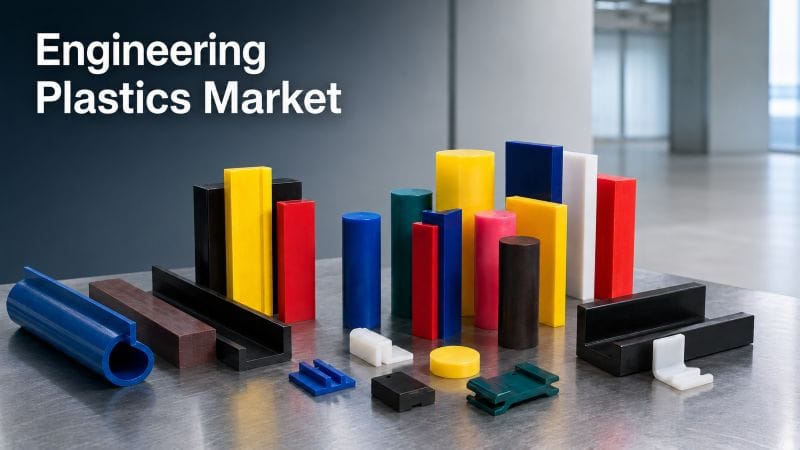
The engineering plastics market is evolving as manufacturers, equipment builders, infrastructure contractors, and industrial buyers look for materials that can provide longer service life, lower maintenance requirements, lower component weight, corrosion resistance, and reliable performance under demanding operating conditions.
Unlike commodity plastics commonly associated with packaging and disposable products, engineering plastics are selected primarily for functional performance. Depending on the polymer grade, they may provide wear resistance, impact strength, low friction, chemical resistance, electrical insulation, machinability, dimensional stability, or a useful strength-to-weight ratio.
These characteristics have expanded the use of engineering plastics across material handling, mining, ports, machinery, construction, chemical processing, electrical systems, logistics, food processing, power generation, and other industrial sectors.
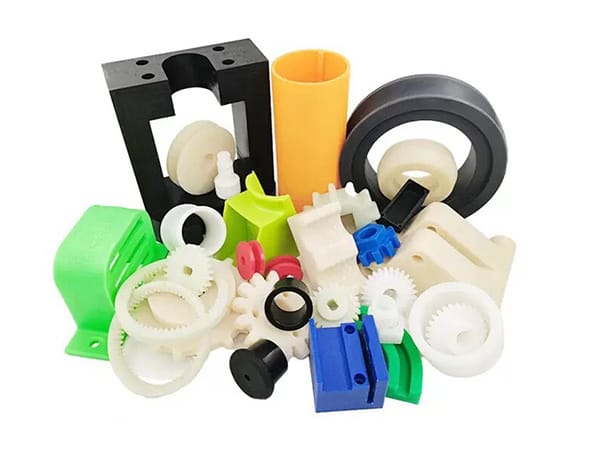
For buyers, however, growth in the engineering plastics market creates a new challenge: there are more materials and more suppliers to compare.
The most important question is no longer simply:
Which plastic sheet is the cheapest?
A better question is:
Which engineering plastic provides the right balance of performance, manufacturability, service life, and lifecycle cost for the actual application?
This guide examines the materials, applications, market drivers, sourcing considerations, and technical factors industrial buyers should understand before selecting an engineering plastics supplier.
Table of Contents
What Is the Engineering Plastics Market?
The engineering plastics market covers polymer materials and fabricated plastic components intended for applications that require more demanding mechanical, wear, chemical, thermal, electrical, or dimensional performance than conventional commodity plastics.
Engineering plastics can include materials such as:
- UHMWPE
- HDPE
- PA6 nylon
- PP
- POM
- PC
- PTFE
- PEEK
- PPS
- specialty polyethylene compounds
- filled and modified polymer materials
At Yunzhan Plastic, the current engineering plastic sheet range includes UHMWPE, HDPE, borated polyethylene, PP and nylon materials for industrial applications.
The term “engineering plastic” should not be interpreted as a guarantee that every polymer is suitable for every application.
A conveyor wear strip, for example, requires very different properties from:
- a chemical processing tank,
- a crane outrigger pad,
- a marine fender facing panel,
- a precision-machined gear,
- or a radiation shielding component.
Material selection therefore needs to begin with the actual operating environment.
Why Is the Engineering Plastics Market Growing?
Several long-term industrial trends support demand for engineering plastics.
Lightweighting and Material Substitution
Manufacturers continue to evaluate where conventional metal components can be replaced or supplemented by lighter materials.
The U.S. Department of Energy explains that reducing vehicle weight can improve energy efficiency and identifies polymer composites alongside metals such as aluminum and magnesium as part of the broader lightweight-material strategy.
According to the DOE, a 10% reduction in vehicle weight can contribute to approximately a 6%–8% improvement in fuel economy under the conditions discussed in its lightweighting research.
For more technical background, see the U.S. Department of Energy’s lightweight materials research.
This does not mean engineering plastics are direct replacements for steel in every application.
Before substituting a polymer for a metal component, engineers need to evaluate:
- mechanical load,
- stiffness,
- creep,
- operating temperature,
- thermal expansion,
- chemical exposure,
- impact,
- dimensional tolerance,
- expected service life.
The growth opportunity lies in applications where polymers offer a practical performance advantage rather than simply a lower material price.
Reduced Maintenance Requirements
Corrosion, friction and abrasion create substantial maintenance costs in industrial equipment.
Engineering plastics may help address these problems in appropriate applications.
For example, UHMWPE is commonly considered for:
- chute liners,
- wear strips,
- chain guides,
- conveyor components,
- sliding surfaces.
Its combination of low friction, impact resistance and wear performance makes it useful in many material-handling applications.
Buyers considering this material can review Yunzhan Plastic’s broader engineering plastic product portfolio to compare sheet materials with fabricated industrial components.
Industrial Automation
Automated production and material-handling systems require large numbers of components such as:
- guides,
- wear rails,
- rollers,
- gears,
- bushes,
- sliding blocks,
- conveyor components,
- precision-machined plastic parts.
As factories increase automation, demand grows not only for polymer sheet but also for finished engineering plastic parts manufactured to drawing.
Infrastructure Development
Engineering plastics are also moving beyond traditional manufacturing environments.
Construction, mining, logistics, ports and utility projects use polymer products such as:
- ground protection mats,
- crane outrigger pads,
- fender panels,
- wear liners,
- plastic covers,
- structural pads,
- fabricated components.
This diversification is an important reason the engineering plastics industry can no longer be evaluated only through traditional machine-building applications.
Which Materials Are Important in the Engineering Plastics Market?
No single polymer dominates every application.
The table below provides a practical comparison.
| Material | Important Properties | Typical Applications | Main Selection Consideration |
|---|---|---|---|
| UHMWPE | Low friction, strong wear resistance, high impact resistance | Liners, guides, wear strips, fender panels, pads | Creep, temperature and loading |
| HDPE | Toughness, chemical resistance, low moisture absorption | Ground mats, panels, fabricated parts | Stiffness and load requirements |
| PA6 Nylon | Higher stiffness, mechanical strength, machinability | Gears, rollers, bushings, pulleys | Moisture absorption |
| PP | Chemical resistance, low density, fabrication capability | Tanks, panels, chemical equipment | Structural load and temperature |
| Borated PE | Neutron attenuation depending on formulation | Radiation shielding | Boron content and shielding design |
| POM | Dimensional stability, stiffness, low friction | Precision machined parts | Temperature and chemical compatibility |
| PTFE | Very low friction and chemical resistance | Seals, sliding components, chemical service | Mechanical strength and creep |
| PEEK | High-temperature and high-performance capability | Aerospace, semiconductor, medical, demanding machinery | Material cost |
The correct choice depends on the operating requirements rather than the popularity of the material.
UHMWPE and Its Role in Wear-Intensive Applications
UHMWPE is one of the most recognizable materials within the engineering plastics market, particularly in wear and sliding applications.
Typical uses include:
- hopper liners,
- chute liners,
- conveyor guides,
- chain guides,
- wear strips,
- marine fender panels,
- dock components,
- sliding plates,
- outrigger pads.
Its relatively low coefficient of friction helps reduce resistance between moving surfaces, while its impact and abrasion characteristics make it useful in industrial environments where continuous contact or material flow causes wear.
Yunzhan Plastic manufactures UHMWPE sheets within its engineering plastic sheet category, including large-format sheets and customizable dimensions.
However, buyers should avoid selecting UHMWPE based on wear resistance alone.
Important design factors include:
- continuous load,
- point loading,
- temperature,
- fastening method,
- thermal expansion,
- exposure time,
- surface pressure.
For additional practical guidance, buyers can also read Yunzhan Plastic’s industrial plastic sheet thickness guide, which discusses thickness, material choice, machining and application conditions.
HDPE Remains Important for General Industrial Fabrication
HDPE occupies a different position in the market.
Compared with UHMWPE, HDPE is generally selected where buyers need an economical combination of:
- toughness,
- chemical resistance,
- moisture resistance,
- impact performance,
- fabrication capability.
Typical applications include:
- ground protection mats,
- outdoor panels,
- tank components,
- fabricated boards,
- industrial covers,
- temporary access systems,
- machined components.
Yunzhan Plastic’s HDPE plastic sheets are available for industrial fabrication and customized applications.
When selecting HDPE, buyers should consider whether the application requires:
- structural rigidity,
- sustained load resistance,
- low-temperature performance,
- outdoor stability,
- machining,
- textured or smooth surfaces.
HDPE should not automatically be substituted for UHMWPE simply because both materials are polyethylene.
Their molecular structures and resulting mechanical behaviors differ significantly.
Nylon Is Important Where Rigidity and Mechanical Strength Matter
PA6 nylon is commonly used where the application requires more rigidity and mechanical strength than polyethylene typically provides.
Common applications include:
- gears,
- rollers,
- bushings,
- guide blocks,
- pulleys,
- bearing components,
- precision-machined parts.
A simplified comparison illustrates why buyers need to evaluate the actual duty.
| Requirement | UHMWPE | PA6 Nylon |
|---|---|---|
| Low friction | Excellent | Good |
| Impact resistance | Excellent | Good |
| Abrasion resistance | Excellent | Very good |
| Stiffness | Lower | Higher |
| Mechanical strength | Moderate | Higher |
| Moisture absorption | Very low | Higher |
| Precision machining | Application dependent | Often suitable |
| Heavy sliding liner applications | Often suitable | Application dependent |
Nylon’s moisture absorption is particularly important because it can influence dimensions and mechanical behavior.
For precision applications, engineers should review both environmental humidity and allowable tolerances before finalizing the material.
Which Industries Are Driving Engineering Plastics Demand?
Demand across the engineering plastics market is highly diversified.
| Industry | Typical Applications | Important Material Requirements |
|---|---|---|
| Mining | Chute liners, wear plates | Abrasion and impact resistance |
| Material Handling | Guides, rails, liners | Low friction and wear resistance |
| Ports & Marine | Fender panels, dock protection | Corrosion and impact resistance |
| Construction | Ground mats, outrigger pads | Load distribution and toughness |
| Machinery | Gears, rollers, bushings | Strength and machining accuracy |
| Chemical Processing | Tanks, panels, liners | Chemical resistance |
| Power Generation | Liners, guides, fabricated parts | Wear and corrosion resistance |
| Food Processing | Guides and working surfaces | Cleanability and compliance |
| Logistics | Conveyor components | Friction and wear performance |
| Radiation Applications | Shielding components | Controlled material formulation |
This broad application base makes the engineering plastics market less dependent on a single industry.
It also increases demand for suppliers capable of both manufacturing material and fabricating finished components.
How Sustainability Is Changing Engineering Plastics Procurement
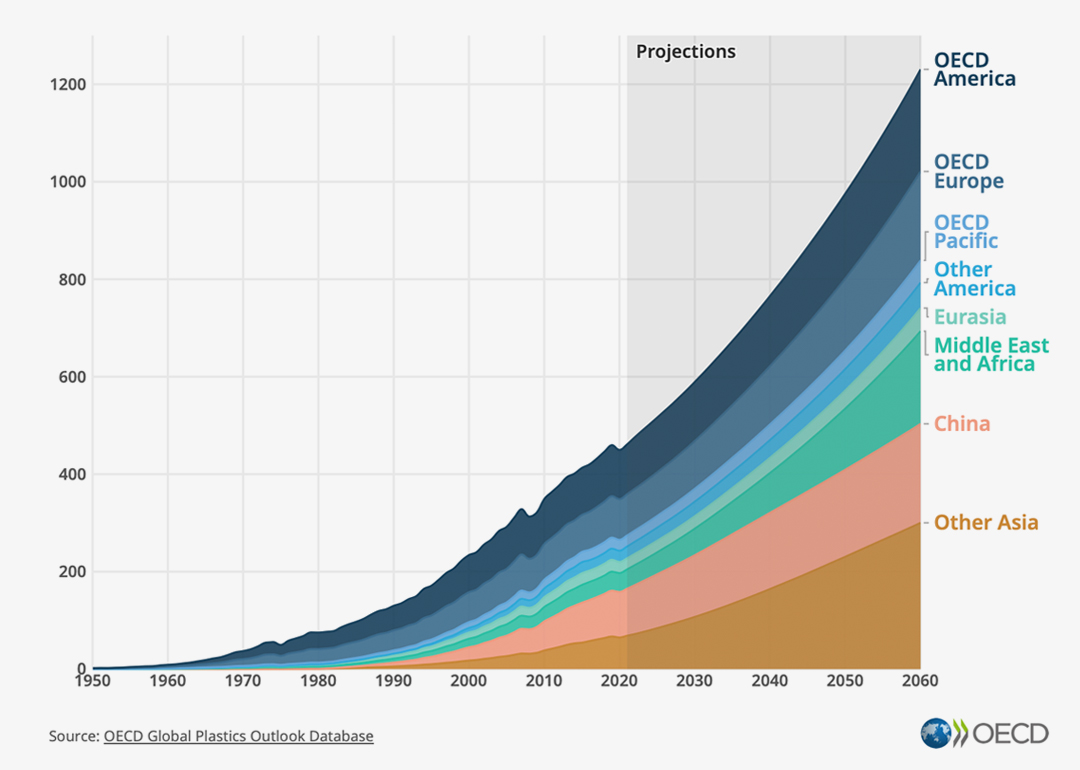
Sustainability is increasingly influencing plastics purchasing, although industrial applications require a more nuanced evaluation than disposable consumer products.
The OECD Global Plastics Outlook shows that global plastics production and plastic waste have increased substantially over the past several decades and emphasizes the need for more circular material lifecycles.
For engineering plastics, relevant sustainability questions include:
- How long does the component remain in service?
- Can the material be recycled?
- Is recycled content technically suitable?
- Does the component reduce maintenance or replacement frequency?
- Can reduced component weight lower transportation or operational energy?
- Does the selected material generate less lifecycle waste?
The U.S. Environmental Protection Agency notes that mechanical recycling remains the predominant plastics recycling approach, but variation in recycled feedstock can create challenges when consistent material properties are required.
See the EPA’s overview of advanced recycling of plastics for additional background.
This point is particularly relevant for engineering applications.
A recycled resin may be entirely suitable for some non-critical products, while another application may require tightly controlled virgin material properties.
Responsible procurement means matching the material source to the technical requirement rather than assuming that either virgin or recycled material is always preferable.
How the Global Engineering Plastics Supply Chain Is Changing
Industrial plastics manufacturing capacity has become increasingly global.
For buyers, this creates more sourcing opportunities but also greater supplier-evaluation responsibility.
Important supplier capabilities now include:
- stable raw material sourcing,
- dimensional control,
- machining capability,
- batch consistency,
- quality inspection,
- drawing interpretation,
- export packaging,
- documentation.
The engineering plastics market increasingly rewards suppliers that can move beyond simply selling sheets.
For example, an international buyer may need:
- Material selection support.
- Cut-to-size sheet.
- CNC machining.
- Drilling or routing.
- Drawing-based inspection.
- Export packaging.
- Repeat production.
This integrated supply model can reduce the number of vendors involved in a project.
From Plastic Sheet to Finished Components
A major shift in the engineering plastics market is the movement toward finished and semi-finished parts.
Instead of purchasing a sheet and sending it to another machine shop, buyers increasingly ask the engineering plastics manufacturer to supply:
- CNC-machined blocks,
- liners,
- wear strips,
- guide rails,
- rollers,
- pads,
- profiles,
- drilled sheets,
- fabricated assemblies.
This means purchasing decisions now involve more than material properties.
Buyers should evaluate:
- CNC capability,
- dimensional tolerance,
- drawing control,
- repeatability,
- edge quality,
- hole positioning,
- inspection procedure.
Yunzhan Plastic provides both sheet products and customized processing solutions through its engineering plastic product range, allowing buyers to source material and fabricated parts from the same supplier.
What Should Buyers Check Before Choosing an Engineering Plastics Supplier?
A technically capable supplier should ask questions about the application before recommending a material.
Buyers should prepare the following information.
| Information Required | Why It Matters |
|---|---|
| Application | Defines performance requirements |
| Material preference | Provides the initial specification |
| Dimensions | Determines manufacturing feasibility |
| Thickness | Influences stiffness, load and weight |
| Temperature | Affects material properties |
| Static load | Important for creep evaluation |
| Dynamic load | Important for fatigue and impact |
| Chemical exposure | Determines compatibility |
| Outdoor exposure | May require UV stabilization |
| Tolerance | Determines machining requirements |
| Quantity | Influences production process |
| Drawings | Essential for customized parts |
| Required testing | Prevents later procurement disputes |
A supplier that immediately recommends a material without understanding these conditions may not have enough information to make a reliable recommendation.
Why Engineering Plastics Should Not Be Purchased on Price Alone
Price comparison is useful only when buyers are comparing equivalent specifications.
Two quotations labeled “UHMWPE sheet” may differ in:
- resin grade,
- molecular characteristics,
- recycled material content,
- manufacturing process,
- dimensions,
- tolerance,
- machining scope,
- quality inspection,
- packaging.
The lowest unit price therefore does not automatically create the lowest operating cost.
A more useful purchasing framework is:
Lifecycle cost = purchase cost + installation + maintenance + downtime + replacement + logistics
Consider a wear liner.
A lower-priced liner that requires frequent replacement can ultimately cost more than a better-specified component with a longer service interval.
This is particularly important in:
- mines,
- ports,
- conveyor systems,
- power plants,
- factories,
where shutdown time may cost substantially more than the plastic component itself.
What Trends Will Shape the Engineering Plastics Market?
Several trends are likely to influence the market over the coming years.
More Application-Specific Grades
Buyers increasingly request materials with specific characteristics such as:
- UV stability,
- anti-static behavior,
- flame performance,
- food-contact suitability,
- controlled boron loading,
- specialized color,
- enhanced wear properties.
More Custom Machining
The market is shifting toward complete components rather than only semi-finished sheets.
Greater Traceability
Industrial purchasers increasingly expect:
- material identification,
- batch information,
- inspection records,
- reliable repeat production.
Continued Lightweighting
Lightweight-material research remains important across transportation and advanced manufacturing.
The U.S. Department of Energy Materials Technologies program specifically examines advanced materials and manufacturing approaches that improve efficiency while maintaining performance.
Greater Focus on Lifecycle Performance
Initial purchase price will remain important, but procurement teams increasingly consider:
- replacement frequency,
- maintenance,
- downtime,
- energy use,
- service life.
More Application Engineering
Industrial buyers increasingly expect suppliers to understand why a component is being used rather than simply manufacture it from a drawing.
How to Select the Right Engineering Plastic

A practical material-selection process should follow:
Application → Working conditions → Required properties → Candidate materials → Testing → Final specification
For example:
If the primary problem is sliding friction and wear, UHMWPE may deserve consideration.
If the priority is higher rigidity and mechanical strength, PA6 nylon may be more appropriate.
If the application requires chemical-resistant fabricated panels, PP may be considered.
If the requirement is ground protection or outdoor panels, HDPE may offer a suitable combination of toughness and fabrication capability.
If the project requires neutron shielding, borated polyethylene may be evaluated as part of a professionally engineered shielding design.
The polymer name alone is never enough to define a reliable specification.
What the Engineering Plastics Market Means for Industrial Buyers
The engineering plastics market is becoming more technical, more customized and more application-specific.
For industrial buyers, this creates opportunities to solve problems involving:
- abrasion,
- friction,
- corrosion,
- impact,
- chemical exposure,
- weight,
- insulation,
- component noise,
- maintenance.
But the increasing number of materials also makes supplier expertise more important.
Yunzhan Plastic’s portfolio includes UHMWPE, HDPE, PA6 nylon, PP, borated polyethylene and customized engineering plastic components. Buyers can explore the company’s engineering plastic sheets and industrial products before submitting drawings or application information.
A responsible supplier should be willing to explain not only what it can manufacture, but also the limitations of a proposed material.
That is especially important in load-bearing, high-temperature, precision, shielding and safety-related applications.
Frequently Asked Questions About the Engineering Plastics Market
What is driving the engineering plastics market?
Growth is being supported by automation, lightweighting, corrosion-resistant components, industrial infrastructure, customized machining and demand for longer service life.
Which materials are common in the engineering plastics market?
Common materials include UHMWPE, HDPE, nylon, PP, POM, PTFE, PEEK and other modified polymers.
What industries use engineering plastics?
They are widely used in mining, ports, machinery, construction, logistics, chemical processing, power generation and material handling.
Is UHMWPE better than nylon?
Not universally. UHMWPE is often suited to wear, impact and low-friction applications, while nylon generally provides greater stiffness and mechanical strength.
How should buyers compare engineering plastics suppliers?
Compare raw material control, manufacturing capability, machining tolerances, inspection processes, documentation, customization ability and technical support—not price alone.
Conclusion
The engineering plastics market is moving beyond simple plastic sheet supply toward technically selected materials, customized components and application-driven solutions.
UHMWPE, HDPE, nylon, PP and specialty engineering polymers each offer different advantages. Their value depends on how well the material matches the actual operating environment.
For industrial buyers, a reliable sourcing decision should consider:
- load,
- temperature,
- wear,
- friction,
- chemicals,
- outdoor exposure,
- dimensions,
- tolerance,
- service life.
The strongest suppliers are increasingly those that combine material manufacturing, machining, quality control and practical application knowledge.
As the engineering plastics market continues to evolve, buyers who evaluate both material performance and supplier capability will be better positioned to reduce maintenance risk and improve long-term component performance.
Need Help Choosing the Right Engineering Plastic?
If you’re unsure about which engineering plastic is best for your equipment, liner, guide, pad, sheet, or customized industrial component, Yunzhan Plastic’s team is here to help. Tell us about your working conditions, dimensions, load, temperature, wear environment, or send us your technical drawing.
Our team can help you compare UHMWPE, HDPE, nylon, PP and other suitable engineering plastic materials for your application.
Contact us today for a personalized material and manufacturing consultation, and make sure your engineering plastic component is designed for reliable long-term performance. Don’t wait until premature wear, corrosion, or material failure increases your maintenance costs—get in touch with Yunzhan Plastic to discuss your project.